Thursday, November 18, 2010

Yummy Bibimbop

0 comments
Bibimbop (BEE-beem-bop) is one of my all-time favorite Korean cuisine.  After doing some research i.e. reading different recipes and watching cooking videos, I realized it's not impossible to make at home. A bonus for me is living in K-Town and having access to the best Korean markets.  This dish can be made in a pan and transferred to a bowl, but since my local Korean market carry authentic hot stone bowls, I decided to cook the rice right in it instead of transferring rice from a rice cooker.  Another advantage of the hot stone bowl is the ability to obtain the nice crispy rice on the bottom of the bowl.  Because the rice continues to cook in the bowl even after its been taken off the burner, by the time you finish eating and reach the bottom of the clay bowl, the rice will be nice and crispy with  a light toasty aroma!


Ingredients:
Steamed white rice
Bulgogi Beef (Sweet marinated beef.  A short cut is to purchase at your local Korean market)
1 carrot, julienned
Cooked bean sprouts,steamed or sauteed in a little sesame oil and seasoned with salt
Cooked spinach,  steamed or sauteed in a little sesame oil and seasoned with salt
Cooked squash, steamed or sauteed in little sesame oil and seasoned with salt
4 shiitake mushrooms, thinly sliced and sauteed in sesame oil and seasons with salt
1 egg, cooked over easy
1 tablespoon sesame oil
Soysauce, to taste
Gochuchang Paste (Can be found in your local Korean market. See picture below)

Instructions:
1) Cook the meat (Bulgogi) in small pan and set aside. 
2) Cook rice in a rice cooker or in a hot stone bowl as seen in the picture. 
3) If cooking rice in rice cooker, transfer rice into a large slightly shallow bowl.  Place Bulgogi (with juices from cooked meat) and veggies on top of the rice. Place separately so you can see each ingredient nicely arranged on the rice. 
4) Fry the egg over easy and place it on top of everything. 
5) Sprinkle with sesame seeds and drizzle with sesame oil and soysauce. 

When ready to eat, mix all ingredients together with some Gougchang paste to taste.  

 Prepare vegetables by cutting and setting aside. 
 Steam or sautee all vegetables and lightly season with sesame oil and salt.
 Arrange vegetables and meat in a way where you can see everything beautifully in the bowl. 
Fry the egg over easy. 
 This is how the bowl should look before the egg is placed on top. 
 This is "Gochuchang Paste" found in your local Korean Market. 
Bibimbap is best accompanied by small side dishes such as Kimchi, pickles and bean sprouts. 

Monday, August 23, 2010

Cambodian Peppered Beef Watercress & Tamarind Shrimp Soup

0 comments
Peppered Beef on a bed of Watercress & Red Onions
Tamarind shrimp soup with squash, tomato, and pinapples  
What a yummy duo!

This dish is great with a bowl of white rice or brown rice. A lemon-garlic-pepper sauce can also accommodate the peppered beef for the ultimate flavor explosion. 

Ingredients:
1) Watercress - 1 bunch washed and dry
2) thinly sliced red onion - use about half
3) thinly sliced beef (I like to buy a good cut like a rib-eye) - for 2-3 people about a half a pound.
4) 1 tablespoon Canola or veg oil
4) Oyster Sauce - 3 tablespoon
5) Fish Sauce -1 teaspoon
6) Sugar - 1/2 tablespoon
7) Garlic - 5-6 cloves minced (reserve half for marinade and half to fry in pan)
9) Ground Pepper -1 tsp (use more until you can see on every piece of meat)
10) Miran (rice wine vinegar) - 1/2 tablespoon
11) Water - 1/2 cup
12) Cornstarch - 1/2 tablespoon

Instruction:
1. Start the marinade for the meat by placing the Oyster sauce, fish sauce, sugar, garlic (half of the reserve), ground pepper and Miran in a bowl. Mix well and give it a little taste. 
2. Place the thinly sliced beef into the marinade. Leave in the fridge for 20-30 min.
3. While meat is marinating layout clean watercress on a large plate
4. place thinly sliced onions on top of watercress in a nice arrangement. Set aside for a bit. 
5. In a small bowl pour in the 1/2 cup water and dissolve the 1/2 tablespoon cornstarch. Stir and set a side for a moment. (Do this just a few minutes before meat is ready to be cooked)
6. Heat a large pan or wok with oil and throw in the half of the reserved garlic. Give it a quick stir to bring out the garlic aroma but be careful not to burn. 
7. Pour the meat and marinade into the pan/wok and cook for a few minutes until meat is cooked. This is where you can add additional pepper if meat is not peppery enough from marinade. If not salty enough, this is a good time to add either a little more fish sauce or salt. 
8. When meat is close to being cooked, place the cornstarch water mixture in. Stir well. 
9. You should have more sauce now with a semi-think consistency. 
10. Turn off heat and gently pour the entire content of the pan onto the watercress and red onions. Make sure to get the liquid marinade is all around the watercress salad and not just the center. 

Lime & Pepper dipping sauce
1) 2 lime (juiced)
2) Ground Pepper -1/3 teaspoon 
3) minced garlic -3-4 cloves minced
5) sugar - 1 teaspoon
6) splash of fish sauce -approx 1/2 teaspoon

Instruction:
1. In a small bowl mix the lime, ground pepper, minced garlic, sugar and fish sauce. 

Best way to eat:
Watercress is really bitter, so try to eat get some marinade juice on the watercress with piece of meat and ladle a spoonful of lime and pepper dipping sauce on top. This is best served with white rice. Enjoy and I would love to hear how it turned out!

Wednesday, August 11, 2010

Grilled Shrimp Salad w/ Coconut Lime Dressing

0 comments
For a warm summer day, there is nothing better than a crisp light salad.  This salad combines classic Cambodian inspired ingredients with a Western presentation.  Grilled shrimp with fresh herbs and tropical fruit are topped off with a yummy coconut lime juice dressing. This recipe is both simple and beautiful to look at. 


Ingredients:
12-14 large or medium shrimp (shell removed, tail can be left on)
1 firm (nearly ripe) mango
generous handful of herbs such as basil, mint and cilantro
1/4 cup sliced red onions
3 cups washed Romain lettuce


Marinade for Shrimp
4 tbsp. oyster sauce 
2 tsp. brown sugar
4 cloves garlic minced 
2 tbsp. cilantro, minced
3 tbsp. fresh squeezed lime juice


Coconut-Lime Dressing
1/2 coconut milk
3 cloves garlic, minced
2 tbsp. fish sauce
3 tbsp. fresh squeezed lime juice
1/2 tbsp. dried crush chili flakes
2 tbsp. brown sugar


Cooking directions:
1. Place shrimp and mango in a bowl. Stir marinade ingredients together in a separate bowl or cup and pour over shrimp and mango. Toss gently and and set aside to marinate while you prep the salad. 
2. Take a small jar and place all dressing ingredients in the jar. Put on the lid and give it a good shake. Taste and add more of what ever you think it needs.
3. Place Romain lettuce in a large bowl. Toss in the the handful of herbs and sliced red onions. Set aside.
4. Skewer the marinated shrimp and fruit onto wooden bamboo sticks.
5. Lightly oil grill and place skewers on grill for 5-8 minutes per side. Shrimp is cooked when it is pinked and plump.
6. Serve the hot shrimp and fruit skewer over the cool salad and top with a generous amount of the dressing. 


Saturday, May 8, 2010

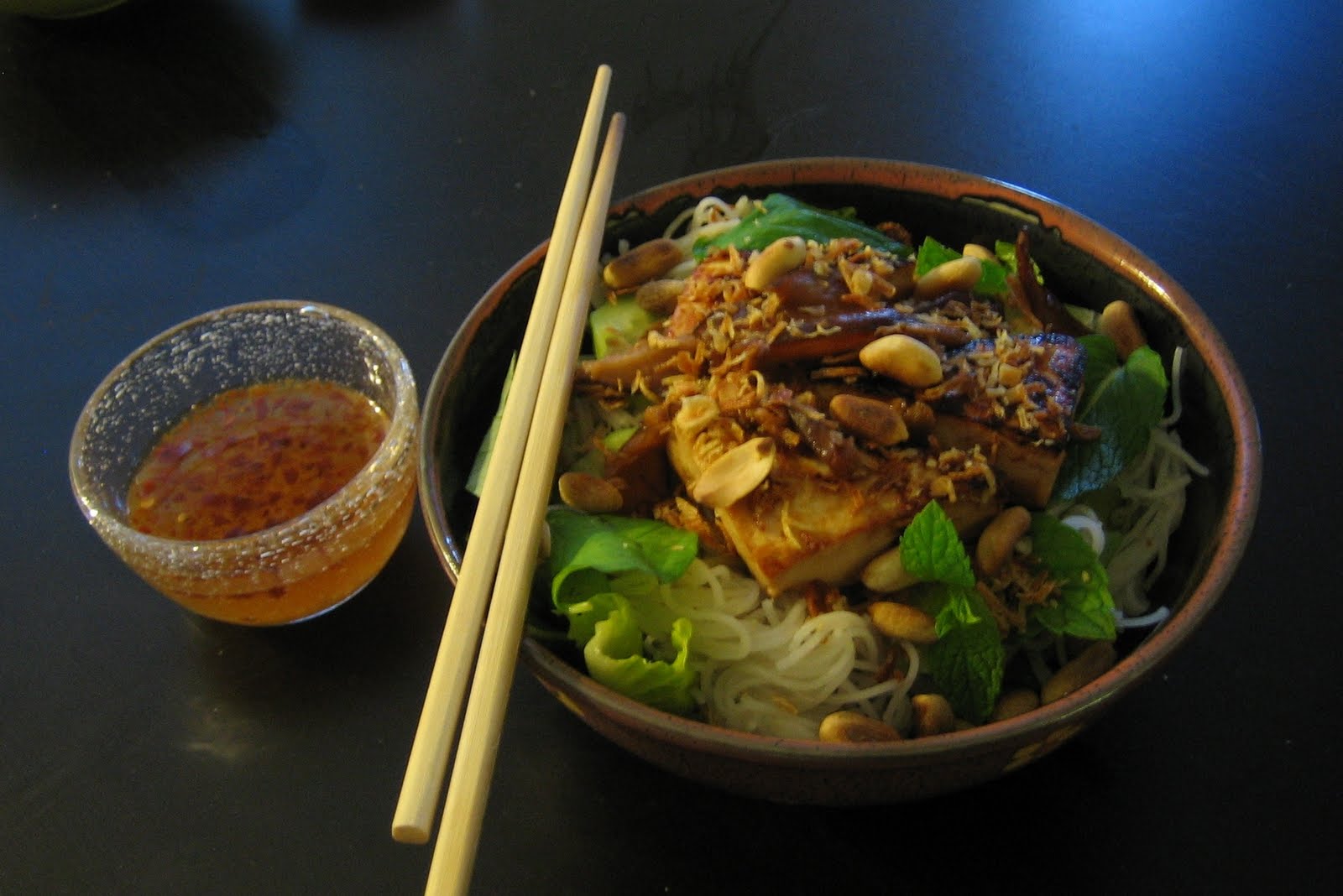
Vegetarian Rice Vermicelli Bowl (Cambodian/Vietnamese)

1 comments
The best thing about Cambodian food is that it is an integration of all South East Asian food.  One of Cambodia's closest neighbor is Vietnam. My mother used to make some variation of a Vietnamese dish when I was growing up and I always thought they were Cambodian cuisines.  Little did I know that she was borrowing tastes and flavors from our neighbor. Since the countries are so close together they share almost identical agriculture and eco-system, thus producing the same types of ingredients.

Fresh Vietnamese herbs are one of my favorite things to eat.  I love the aroma, crispness and freshness of the herbs. There are many variation of fresh herbs, basil and mint being the most well known. The lesser known herbs are Fish Mint, which has a slight fish aroma and taste. This doesn't sound appetizing, but the taste of the Fish Mint mixed with the noodles, fried shallots and other ingredients is tantalizing. Vietnamese Coriander is another fresh mint I like to use. It is more slender and longer than the Fish Mint and has a spicy with a hint of cilantro taste.


Essentially, my inspiration for tonights meal was Fresh Vietnamese herbs.  With the weather getting warmer and the desire to look good in a bikini, I wanted to cook something fresh, light and refreshing which is exactly what this dish offered. The picture below is a vegetarian bowl, but you can add all sort of meats and seafood to the recipe.


*Ingredients & Instructions to come shortly.

Monday, March 8, 2010

Utah's Teo Chew Egg Noodle Soup

1 comments
My brother Utah came up the the great idea of having guest bloggers on my site. This blog was originally established as a way for me to document traditional home cooking from my Cambodian and Teo Chew heritage.  Having my brother contribute recipes of dishes he remembers from our childhood is so very befitting! I encourage any family members and friends to submit recipes. I would love to incorporate your favorite dishes and share old memories together.

This is a Teo Chew style noodle soup.  You might be wondering what is Teo Chew and why is it different from plain old Chinese? There is a great difference. Most Teo Chew people are displaced Southern Chinese folks who immigrated to all different parts of South East Asia. The original region in China that the Teo Chew people inhabited was very different from the rest of  China. They had their own distinctive food, language and traditions. When almost the entire population of this group immigrated to South East Asia they blended their already distinctive flavors and ingredients with that of the South East Asian flavors and ingredients. Although it no longer exist, most of the heritage from that region is carried on through immigrants living all across South East Asia. Over time, the blend of South East Asian flavors and Chinese flavors combined to make something rare and unique.


Ingredients for 2 servings:
1 package uncooked egg noodles (wide or thin)
1 can chicken broth
1.5 cup water
1 pinch of salt
1 teaspoon sugar
1 tablespoon soy sauce
1 clove garlic (diced)
1 cup fresh bean sprouts
2 stacks diced green onions
1/2 lbs Bok Choy
1 package *Vietnamese pork patty (you can subsitute w/ beef or fish balls)
*Vietnamese pork patty is popular amongst the South East Asian community. They are processed pork meat that is pre-cooked. They are yummy, convenient and can be used in many soup dishes.

Cooking directions:
Bring a large pot of boiling water to a boil. Add the egg noodles. When the noodles float to the top (about 30 seconds), rinse in cold water, drain and set aside. 

Slice the pork patty into thin slices. In your serving bowl, throw in the patty slices along with the bean sprouts. Portion out the cooked noodles and add them to the bowls.

In a medium pot, heat some oil and saute the diced garlic till it is golden brown. Add the water and chicken broth and let is simmer. I usually add 1 parts broth and 1 parts water. Add the salt, sugar and msg (optional). Add the soy sauce to taste. Add the green onions and bok choy.  You don't want to let the veggies cook too long. I usually turn off the heat before adding them. 


Happy eating,
Utah Iev


Tuesday, February 23, 2010

Spicy Miso Ramen

0 comments
 

This is a simple and easy recipe for anyone who wants to try a hand at making homemade Japanese ramen.  I made this dish this evening and it was a real crowd pleaser! A large bowl of ramen is great on a cold wintry day, when you want something warm and yummy in your tummy!  (Recipe adapted from  Rasa Malaysia w/ a few variations)


Ingredients:
Fresh Ramen noodles (for two)
4 cups water
4 tablespoons white miso paste
4 tablespoon chili oil
1/2 teaspoon hondashi (Bonito Fish Soup Stock) 
1 lbs white mushrooms (sliced in half)
2 hard boiled eggs
1/2 can corn kernels
1 Narutomaki (Japanese fish cake w/ pink swirl)
1 stalk scallion (finely chopped)
1 tablespoon sesame seeds (pound with mortar and pestle until fine or find any other method to mash it until its fine and powdery)
Season roasted seaweed (cut into strips)
Toasted shallots (can be bought pre-made in a jar at any Asian market)

Cooking Directions:
1. Bring water to a boil and add 4 tablespoon of white miso paste, hondashi, eggs, sliced mushrooms and finely ground sesame seeds. 
2. Bring the soup base to a boil and reduce heat and let it simmer for about 10 mins. 
3. Add the chili oil.
4. Blanch the ramen noodles in a pot of boiling water until they are cooked. Rinse with cold running water, drain and set aside. 
5. In a large bowl, add the noodles and then top it with the hard-boiled egg (sliced into half), nartomaki, corn kernels, roasted seaweed, chopped scallion and toasted shallots. Pour the miso soup into the bowl and add the roasted seaweeds. Serve immediately. 


Wednesday, December 2, 2009

Scrumpcious Eggplant Lasagna

1 comments
I've only made lasagna once in my life and I butchered it terribly.  It took me a long time to muster up enough courage to attempt it again, but on a lazy Sunday with time on my side, I decided to give it another go.  This time around I had the proper tool and knowledge to finally do it right.  It came out delicious and much lighter than your usual meat lasagna. I found this recipe by Danny Boome, but modified it a bit. Most of the time eggplant is used in replacement for lasagna noodles/panels for people who are vegan or on a low/no carb diets. I just wanted to make lasagna without meat, so I figured I would use traditional lasagna noodles in conjunction with the eggplant. No meat, but the eggplant gave the lasagna a hearty and robust taste. 


Ingredients
1 box dried lasagna
6 cup water
2 large eggplants, sliced (3/4" thick length wise)
5 tbs olive oil
coarse salt & fresh ground pepper
2 garlic cloves, minced
1 cup sliced cremini mushrooms
1 (15-ounce) whole milk ricotta cheese
3 large eggs
1 cup Parmesan (divided)
2 tablespoon chopped oregano leaves
2 cup Marinara sauce (see below for recipe)

Instructions
Preheat oven to 400 degrees F.

1. Arrange sliced eggplant in a single layer on two baking pans.
2. Brush each slice off eggplant with olive oil (approx 3 tbs of olive oil). Sprinkle salt and pepper and do the same for the other side.
3. Roast eggplant until soft and golden. Turn slices half way through (bake for about 25 mins).
4. Bring a large pot of boiling water to a rolling boil (about 6 cups).  Add a dash of salt and 6 lasagna noodles into boiling water. Cook uncovered until al dente. Drain water when done.
5. In medium skillet add remaining 2 tbs olive oil and sliced mushrooms and chopped garlic (about 5 mins until mushroom is soft). Once mushroom is cook set it aside and let it cool.
6. In a large bowl add the ricotta, eggs, 1/2 cup Parmesan, oregano, mushrooms, 2 teaspoons of salt and 1/4 teaspoon pepper. Mix well. Brush an 8" rectangular baking dish with oil.
7. Ladle a few spoonful of Marinara sauce in the baking dish and lay 2 pieces of lasagna side by side. Add 2 slices of eggplant on each lasagna panel. Layer on the ricotta mixture. Ladle more sauce on top of ricotta mixture. Add another layer of lasagna panels, eggplant, ricotta mixture and Marina sauce. Add the last two lasagna panel and ladle sauce to completely cover lasagna.
8. Sprinkle the remainder of the 1/2 cup Parmesan cheese (optional to add 1/2 cup mozzarella cheese).
9. Bake in 350 degree oven for 30 minutes.

Marina Sauce

Ingredients
5 clove garlic
course salt and freshly ground black pepper
1/4 cup tbs extra virgin olive oil, divided
1 large onion, diced
2 carrots, peeled and diced
2 tbs tomato paste
1 cup fresh basil leaves
2 tbs chopped oregano leaves
1 (28-ounce) can Roasted Crush tomatoes

Instruction
1. Preheat oven to 400 degrees
2. Peel 5 cloves garlic and place them in a square of foil. Sprinkle salt and pepper and drizzle approx 2 tablespoon olive oil. Create a leak proof pouch and roast for 25 mins directly on oven rack at 400 degrees.
3. In medium sauce pan, saute onions and carrots with the oil.  Add tomato paste and stir well. Cook off the tomato past (about 5 mins). When vegetables are soften add the roasted garlic, salt, pepper, basil, oregano and stir together until incorporated. Pour in the tomatoes. Fill the empty can with water (almost to the top, but not full)
4. Bring to a boil then lower the heat to a simmer. Simmer for 1 hour, uncovered. Stir and taste occasionally. (carrots and onions are supposed to sweeten the sauce, but if it is too tart, add 1 teaspoon of sugar).
5. Once sauce has been simmering for 1 hour and has thicken. Remove from heat and pour into blender or food processor. Blend until smooth.